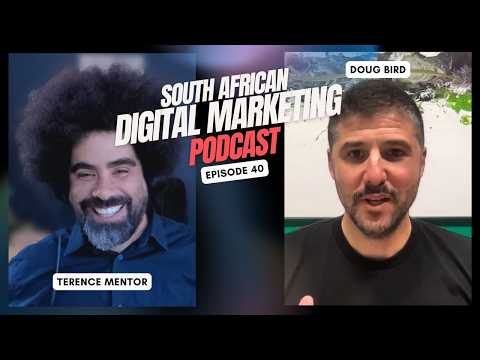
 40 min · Watch the episode
Listening is always free. Watch on YouTube, Spotify, or Apple Podcasts.
What this episode is about
Doug Bird has spent more than twenty years in South African experiential marketing: running operations on multi-day sporting events, building his own sports marketing agency, five years as head of sports marketing at Red Bull, and now Wild Air. Budgets are swinging back from digital towards in real life, so we asked him the obvious question. Is in-person marketing still worth the time, money and hassle?
His answer starts with a step back. Digital won the budget partly because it is easy to defend in a board meeting, not always because it connects best. In-person work, he argues, can be as measurable as digital if the systems are in place before the idea. We cover how Red Bull measured its events, why smaller brands are winning on the ground, why there is no such thing as an easy win you haven't prepared for, and the platform he is building to make buying in-person connection work more like buying media.
Three things we took away
- Digital often wins the budget because it is easier to defend. Doug's diagnosis is structural. Marketers tend to build around what they will need to justify later — "how am I going to be safe in the next board meeting?" Digital hands you the numbers for that meeting: the engagement rate, the comparison to the industry average. So the split between digital, traditional and in real life comes from "what is going to enable me to deliver the best reported outcome, as opposed to what is going to best connect with my consumer."
- In real life is measurable, if the systems come first. At Red Bull his job was getting as many cans into the target market's hands as often as possible, and everything started on the ground. At events like Red Bull X-Fighters they counted interactions at each point of sale and activation, and a Red Bull Mobile sign-up for free Wi-Fi on site captured first-party data. With automotive brands the same thinking drives lead generation. "The missing layer is more systems," he says, which is why he now treats the idea as the last step: set the outcome, build the system, "and then you reverse engineer that against what you're going to do."
- Small brands are winning by going where their customers already are. His example is Saucony, which could not outspend Nike, Asics, New Balance or Adidas. So it went to run clubs with a trailer, 25 pairs of shoes, music and camera crews. For a 50K budget it came away with a lead list of around 50 people per execution and a stream of real reactions to push into digital: "that whole flywheel starts to turn." The brands that get it wrong build their own playground while their customers are "playing in this park" next door. And underneath all of it: "in the most successful brands that I've seen in real life, it comes back to word of mouth."
Our guest: Doug Bird, founder of Wild Air. Connect with Doug on LinkedIn.
Want a straight answer on your own marketing?
I'm Terence, the host. Through TM Digital I look at what businesses spend on marketing and tell them what's working. I don't sell the work, so I can judge it honestly.